technology |
|||||||||||||||
 |
|||||||||||||||
 rofessional prognosticators in the last century predicted the new millennium would witness wonders such as plants that produced porterhouse steaks, work weeks that lasted just 16 hours, and trade shows that would be held in interplanetary "cosmotels" you could travel to by "volkscapsules" or "satellacs." Those marvels remain as elusive as the personal jet pack. rofessional prognosticators in the last century predicted the new millennium would witness wonders such as plants that produced porterhouse steaks, work weeks that lasted just 16 hours, and trade shows that would be held in interplanetary "cosmotels" you could travel to by "volkscapsules" or "satellacs." Those marvels remain as elusive as the personal jet pack.But a few others who peered into their crystal balls a little deeper got it right. By looking at then-current technology and extrapolating from it, AT&T Inc. was as accurate as your GPS in a series of TV commercials 20 years ago that foresaw e-readers, voice-recognition software, electronic health records, virtual meetings, and even streaming movies. So, like the telecommunications giant, we didn't boldly go looking for Star Trek-like technologies that always astound and amaze though rarely arrive. Instead, we searched for the technologies that are here now, but which will soon accelerate from cruising to warp speed. When you glimpse the marvels we highlight, we think you'll agree that, just as science-fiction legend William Gibson once said, "The future has already arrived. It's just not evenly distributed yet." In fact, we'll bet our jet packs on it. 1 Near Field Communication In 2002, NXP Semiconductors NV and Sony Corp. invented the fundamental technology for a new wireless gizmo called Near Field Communication (NFC). Comprising an antenna and/or a programmed subscriber identity module (SIM) or secure digital (SD) data-card chip that use a short-range wireless technology, NFC-enabled devices can communicate with one another in close proximity. Able to transmit data over distances of less than 4 inches, NFC technology has a diminutive size and multiple functions that make it a perfect addition for cell phones, since it enables them to send, receive, and play video, audio, and text files; serve as tickets to gain entry for events; and even make purchases - all just by waving your phone at another nearby NFC-enabled device. The technology appeared when Japan's cell-phone carriers began offering a version of it called Mobile Felica, which allowed mobile phones to act as credit cards and transit passes. How fast is it taking off? NFC technology will be more widely available later this year. Cingular Wireless LLC and Citibank N.A. did a dry run with NFC in New York in 2007, by permitting a test group to access the city's subway system wielding their NFC-equipped cell phones as transit passes. Sprint Nextel Corp. carried out a similar test with San Francisco's subway system a year later in 2008, but the technology's adoption has been hobbled by the reluctance of telecom companies, banks, and credit-card companies to agree on universal standards for accepting NFC transactions. 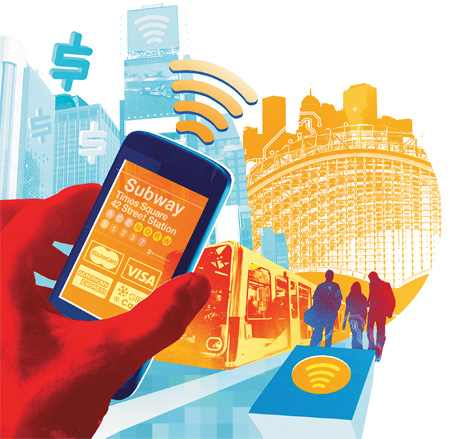 That inertia will soon veer off in a different direction, however. While the technology allows people with NFC-enabled devices to do everything from exchange electronic business cards to enter a multiplayer game, the momentum behind its growth is the allure of a quicker, easier way to make purchases. Recognizing the shift, Verizon Communications Inc., AT&T, and T-Mobile USA Inc. joined ranks in 2010 with credit-card issuers to offer Isis, an NFC-based mobile-payment technology. That inertia will soon veer off in a different direction, however. While the technology allows people with NFC-enabled devices to do everything from exchange electronic business cards to enter a multiplayer game, the momentum behind its growth is the allure of a quicker, easier way to make purchases. Recognizing the shift, Verizon Communications Inc., AT&T, and T-Mobile USA Inc. joined ranks in 2010 with credit-card issuers to offer Isis, an NFC-based mobile-payment technology. Isis secured agreements with major payment processors a year later in 2011: a roster including American Express Co., MasterCard Inc., Visa Inc., and Discover Financial Services. With those heavy hitters in its lineup, Isis is poised to roll out a mobile-commerce program in Salt Lake City and Austin, TX, by mid-2012. Additionally, PayPal Inc. released an app in late 2011 that allows users with NFC-enabled phones to exchange money. The result of all that corporate synergy is a technology that should take off like Angry Birds: Market-research firm Allied Business Intelligence Inc. (ABI) Research forecasts that by the end of 2012, 20 percent of all cell phones will be NFC enabled. Moreover, Forrester Research Inc. projects that by 2013, that number will leap to 25 percent. Google Inc.'s forecast is even more sanguine, estimating that by the end of 2014, fully half of all cell phones will be equipped with NFC technology. At least 40 models of smart phones currently have the technology built into them (although you won't be able to use that function until merchants start offering the hardware/software necessary to enable NFC-based transactions) such as Google's Nexus S, Samsung Electronics Co. Ltd.'s Galaxy S II, and Research in Motion Ltd.'s BlackBerry models Bold 9790 and Curve 9380. The iPad tablet, too, is now NFC capable. "NFC will have a huge impact on exhibiting and events," says Ivan Lazarev, CEO and co-founder of ITN International Inc., a Bethesda, MD-headquartered company that creates mobile-marketing, lead-management, and attendee-tracking solutions for events and exhibits. "Exhibitors will be able to offer more info more quickly and conveniently than ever, and even sell on the trade show floor, all with a simple wave or touch of a phone." How are exhibitors using it? NFC-enabled smart phones have only just appeared recently, but some early adopters have already answered the emerging technology's call. Harris Corp., a communications and information-technology firm, used NFC to empower salespeople in its booth at the International Broadcasting Convention (IBC) in Amsterdam, a show geared for the TV broadcast industry. After outfitting 10 staffers with NFC-enabled smart phones, the Melbourne, FL-based company read attendees' NFC-equipped badges with a simple touch of the phones. Along with the phones' program allowing staffers to qualify the interaction with that prospect, Harris immediately used the data culled from the badges to deliver customized information via e-mail to visitors within five minutes after they departed the company's booth. Furthermore, for those visitors who met various criteria set by Harris management, staffers loaded a virtual ticket on their NFC-augmented badges that gave them access to a private beach area outside of the convention center. Once attendees with tickets sauntered over to the outdoor oasis, more Harris staffers, also equipped with NFC-enabled phones, could read the digital ticket and usher the guests to some sun and fun. In fact, the next year at the 2011 IBC, Harris later evolved its use of NFC into a tool that empowered attendees as much as it enhanced the company's ROI. Concerned that 50 percent of booth visitors to its exhibit at various shows were deliberately avoiding salespeople, the company decided the best course was not to become more aggressive in its approach but, with the help of NFC, to let attendees help themselves. The company attached NFC antennas to nine NFC-capable iPads, then encased them inside stationary kiosks called BouncePads. In turn, Harris tethered the BouncePads to horizontal surfaces throughout the booth. The unmanned stationary devices allowed guests to discover virtually anything they wanted about the company's broadcast-related tech, from video servers for TV stations to audio-management systems for radio studios. First, Harris downloaded and installed a program on the iPads from iTunes called Bcard Reader Browser, made by ITN International. Then, whenever staff-averse attendees touched their NFC-equipped badges to the iPads (information on the screen showed booth visitors how to use them), their name, industry, company, job title, and location were captured by the Bcard Reader Browser, after which it launched a microsite on the screen. The site's personalized welcome page, customized on the fly based on information contained on the scanned badge, greeted the guests by name, then offered them a map of the 5,000-square-foot-booth, a portfolio of the company's newest products, and an order form for product literature.
By offering this convenient work around for staff-averse attendees to visit the booth and retrieve product information without the risk of close encounters of the sales kind, Harris generated 20 percent more leads than it did the previous year. Where can I find out more? Several sites offer solid introductions to NFC that don't require a Ph.D. in electrical engineering or computer science. Near Field Communication Forum is a nonprofit industry association promoting the technology with an excellent primer in its FAQ area, covering everything from how NFC works and how fast it transmits data to how it's similar to other wireless technologies. NFC World, meanwhile, is a trade publication that rounds up the latest news from companies using or testing NFC, lists NFC-capable phones on (or coming to) the market, and details events in the industry. For those who like their information the old-fashioned way, there's also a paperback book, "Getting Started with RFID and NFC," by Brian Jepson and Tom Igoe, available at Amazon.com. 2 Tablet Computers Possessing 5- to 12-inch displays, pad-based computers, aka tablets, are a hybrid of smart phones and laptops, offering the ability to read books, surf the Web, play movies and games, and more. Many use virtual keyboards and handwriting recognition for text input through a touchscreen. Furthermore, at least two companies have introduced 3-D tablet computers that don't require special glasses, with more models expected before the end of 2012.
Originating during World War II to help differentiate allied aircraft from the Axis planes, Radio Frequency Identification (RFID) comprises a microchip attached to a curly radio antenna set on a substrate, which is usually referred to as a "tag." The microchip can store approximately two kilobytes of data, which the antenna transmits to a computer, or a "reader." The reader in turn sends radio waves to, and receives signals back from, the tag. Typically, RFID is employed to communicate information between a stationary reader and moving objects - e.g., attendees in your booth wearing RFID tags - over short distances of up to 100 feet.
As the guests migrated from station to station, the RFID readers automatically recorded their visits (but not visitors' names or personal data). Attendees could then monitor their score by visiting any of four "Check Your Points" stations, before finally grabbing a prize at the gift center. The results were so stunning, they should probably have been illegal: Thomson Reuters recorded 950 individual booth visitors (55.8 percent of the show's approximate total of 1,700 attendees) who visited an average of 6.59 product stations. With the RFID-supplied metrics, Thomson Reuters was able to prove beyond a reasonable doubt that its WestlawNext Mobile (a legal-research app) and Westlaw Court Wire (an app that delivers info on new litigation and court decisions) were the most visited product stations in the booth, while simultaneously identifying products that, due to lower interest levels, could be scrubbed from future booths to decrease clutter and allow a more open floor plan.
|
|||||||||||||||
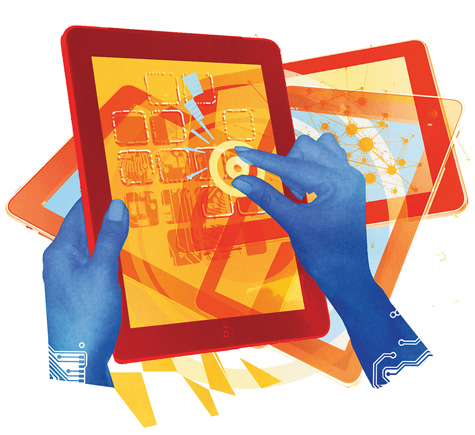 Despite a false start with Microsoft Corp.'s pen-enabled Tablet PC in 2001 that never took off, the tablet computer burst on to the scene when Apple Inc. launched the iPad in April of 2010. Selling nearly 13 million iPads in its abbreviated first year, Apple launched the first major salvo in the rise of tablet wars - but certainly far from the last. Competing manufacturers are issuing their take on the iPad the way AOL Inc. used to bombard consumers with its software disks. Nearly 80 tablets were introduced at the 2011 International Consumer Electronics Show (CES). By the end of 2011, 64 companies would be producing an estimated 102 tablets, according to management-consulting firm PRTM. Of the dozens of models available, the most popular include Samsung's Galaxy Tab, Dell Inc.'s Streak 7, Research In Motion's BlackBerry-branded PlayBook, and of course, Apple's iPad.
  Hoping to sign up 200 people for the giveaway, the company signed up more than 500 - and also compiled a database of prospects it could contact after the show. By simply using the iPad as a way to physically liberate staff and customers from the more rigid confines of stationary PCs and the booth, it hit the right note with attendees, playing to an image that was more laid-back than uptight.
 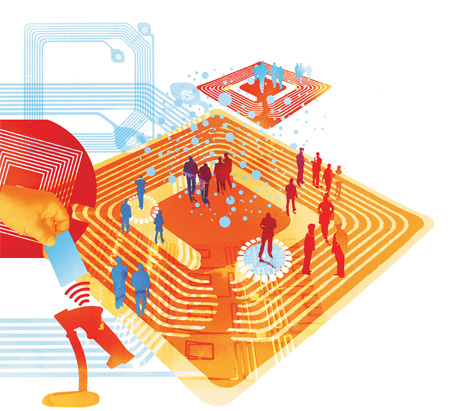 About 2.4 billion RFID tags were sold from 1946 to 2006, according to IDTechEx Ltd., a Cambridge, U.K.-headquartered consultancy that researches the printed-electronics industry. The market has magnified so rapidly in the last few years with so many different types of RFID tags available - from tags that track your pets to those that monitor the military's cargo containers - reliable statistics are difficult to pin down.






Marketplace

- Audiovisual Equipment
- Convention Centers
- Event Design and Production
- Exhibit Fabrication
- Exhibit Producers
- Exhibit Rental
- Experiential Agency
- Flooring
- Graphics
- International Exhibit Producers
- Kiosks
- Lead Retrieval
- Modular Exhibit Systems
- Portable Display Systems
- Shipping and Transportation
- All Companies
3048R Sales and Marketing Alignment: How to Get ‑ and Stay ‑ on the Same Page
Feb. 10, 2026
3011R How to Grow Your Brand: Incorporating Brand Marketing into Your Exhibit Program
Feb. 19, 2026
4101R Boost Up: Promote Yourself from Service Provider to Strategic Business Partner
Mar. 3, 2026
6020R The @show Experience: Understand the Essentials of Exhibit Design
Mar. 10, 2026
7058R Authors Executive Series: Thrive Under Deadlines: Strategies for Success
All Sessions >>