insight

Coping for Well-Being
Coping is a critical factor in business profitability, says Karen L. Jones in her book “The COPE Factor.” But if you think coping is a mere survival skill that can make the workplace more satisfactory, Jones says not so fast. Coping and the mechanisms involved offer broader insight into the wellness or weakness of an organization and its members. By Nancy Olson
Karen L. Jones
 Author, speaker, and transition strategist Karen L. Jones brings more than two decades of experience to her work as founder and CEO of Mission2Transition. Here, she works with professionals, executives, creatives, and organizations in times of change.
Jones is the executive director of Global and Graduate Programs and adjunct professor at the University of Houston Law Center and has served on the faculty at Columbia College Chicago and Rice University Houston. Her international work includes sports law, compliance, governance, and program leadership. Her book, “The COPE Factor,” is a functional guide for business leaders, managers, and professionals navigating today's multifaceted work environment. And if you're ever fortunate enough to hear Jones speak, her background in theater ensures riveting presentations.
EXHIBITOR magazine: In the workplace, how do you define coping?
Karen Jones: People adopt coping mechanisms when something in the organization isn't functioning properly or when they lack reasonable alternatives to deal with dysfunction.
EM: I've always thought of coping as a positive response to untoward events, whether in the workplace, at home, or on the trade show floor where circumstances can turn on a dime. But you seem to take a different approach to your definition of coping.
KJ: It's true that coping helps us navigate situations that might otherwise break us, but there are problems associated with coping strategies in the work environment, including the suppression of ideas, disengagement, disruption, and quiet quitting. These negatively impact businesses because they affect an organization's most important resource — its employees.
EM: Would you give me a few examples of reasons why people might develop coping mechanisms at work?
KJ: There are many, but I'll touch on a few here to illustrate. A big one is a failure to rectify a situation. For example, when employees strive to fix a problem, offering various solutions and suggestions, yet things don't improve, frustration sets in, which may lead to anger and resentment. Coping mechanisms might include workplace disruption and lack of cooperation, or employees may no longer try to make changes outside their immediate responsibilities. Another big one is unclear guidance or a lack thereof. Without good direction from management, there's confusion. This can hamper employees' abilities to perform, leading to a loss of confidence and, often, disengagement.
Interestingly, all the workplace coping mechanisms have one thing in common: The employee has given up in some way and enacts a fight or flight response, wherein one may choose to stay or leave the workplace to seek a more desirable situation.
EM: What are some coping strategies you've observed when an employee decides to stick it out and stay?
KJ: They can include defensiveness, sabotage, absenteeism, complacency, and withdrawal. Identifying them for what they are is critical to understanding the problems associated with them. But it's important to understand that coping strategies are not always intentional and may be subconscious.
EM: Your observation of “outside factors” as a reason for coping in the workplace is particularly important.
KJ: It's nearly impossible to ignore the intersection of our personal and professional lives. External events, such as family, health, or financial concerns, may impact an employee's behavior at work. Examples would be the COVID-19 pandemic, when our lives — at home and at work — were turned upside down, and we were forced to cope in various ways. Trade shows, which are built on the importance of face-to-face relationships, went virtual. Employees were dealing with lost income, homeschooling their kids, fear, restlessness, and more.
 A manager's failure or refusal to recognize his or her employee's potential can reduce a company's productivity and profitability. Know your employee's skill set so you don't suppress what could be valuable input.
KJ: True, and that can lead to low morale and withdrawal. A failure or refusal by management to acknowledge employees' potential can reduce a company's overall productivity and profitability. If you're unaware of an employee's skill set, you might assign them to an ill-fitting role. Or if you know their talents but discourage them in some way, you suppress their valuable input.
EM: What steps can organizations take to build a healthy workplace?
KJ: Determining the organization's Cope Factor as outlined in my book provides a great place to begin. It provides an in-depth look at what's going on in an organization, and it gives space for positive change. It all starts at the foundation, which is critical to establishing a well-functioning business. A solid foundation must be robust enough to support the business's start-up needs as well as its potential future growth. Regular transparent assessments at important junctures are also important to monitor goals, strategies, and values. Is everything functioning smoothly and continuing to meet the organization's evolving needs? For example, if your business values remain unchanged, but your employee base has shifted, it's time to reassess. Communication, both written and verbal, is an absolute requirement for a good work environment. So are clearly defined business values, demeanor, and role definition, among others.
EM: Generally, what information does determining an organization's Cope Factor provide?
KJ: The process measures the level of business dysfunction or, conversely, the wellness of a business. When implemented correctly, it measures the degree to which coping mechanisms are present in the workplace. A high Cope Factor indicates serious dysfunction, while a low Cope Factor indicates the organization or department has little or no dysfunction and employees are more focused and productive. The Cope Factor is ultimately determined by an assessment that involves a series of questions weighted according to employee coping behaviors like “disruptive” or “confrontational” or “disconnected.” Key factors are then rated to determine whether there's a high or low Cope Factor, and guided assessments further sharpen the overall picture. Data is compiled into the Cope Factor Organizational Assessment Checklist, the results are averaged and analyzed, and an action plan is identified.
EM: What happens after the action plan is in place?
KJ: Implementation is key to success, and this includes designating project leads, setting deadlines, and ensuring accountability. Ongoing monitoring of these factors will ensure that improvements are sustained.
EM: Can businesses complete the process themselves?
KJ: Some may find it challenging and prefer the involvement of an external or neutral party. But whether alone or with assistance, it's an essential process to foster a healthy workplace, and it offers a better understanding of what it means to cope.
EM: Have you discovered any recurring themes in your work?
KJ: “We've always done it this way,” is one. Change is difficult and resistance is not uncommon, but part of my job is to make it more palatable and meaningful. I always ask, “What makes you happy?” E
The COPE Factor:
Increasing Productivity and Profitability by Improving Workplace Well-Being.
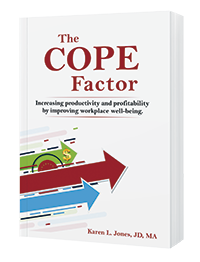 Written and published by Karen L. Jones, J.D., M. A., “The Cope Factor” offers a plethora of information about a topic that the author has spent years researching, most recently as founder and CEO of her consulting company, Mission2Transition LLC. “The COPE Factor” addresses how the act of coping in the work environment impacts effectiveness and productivity, and it provides solutions that can improve workplace well-being to ultimately improve the bottom line.
The book explains how coping is a response to stress, and by addressing it proactively according to Jones's guidelines, many of the potential negative consequences of coping may be ameliorated. She covers a broad range of topics within the information-packed 87 pages, starting with defining what an organization really is: a group working together toward a shared goal. She moves on to coping behaviors as means to deal with dysfunction within an organization, then discusses how to rate various coping behaviors to determine the Cope Factor (CF) of the organization and its members. The final chapters include how to tailor assessments — individual and organizational — and what to do with the results, whether the Cope Factor is high or (preferably) low.
Jones advises that managers should be involved in helping to determine the Cope Factor for their departments, while executives should be involved in assessing the Cope Factor for the organization as a whole, being sure to include employees in the process. Sample action plans are given, along with expected outcomes, proving the author's premise that knowing one's Cope Factor is critical to an organization's likelihood of long-term success.
A companion book is in the works: “The COPE Method for Employees.” It expands the COPE model to support individuals facing burnout, disengagement, or misalignment at work, offering an option to shift work lives without burning out or selling out.
For more information: mission2transition.com.
Increasing Productivity and Profitability by Improving Workplace Well-Being.
Written and published by Karen L. Jones, J.D., M. A., “The Cope Factor” offers a plethora of information about a topic that the author has spent years researching, most recently as founder and CEO of her consulting company, Mission2Transition LLC. “The COPE Factor” addresses how the act of coping in the work environment impacts effectiveness and productivity, and it provides solutions that can improve workplace well-being to ultimately improve the bottom line.
The book explains how coping is a response to stress, and by addressing it proactively according to Jones's guidelines, many of the potential negative consequences of coping may be ameliorated. She covers a broad range of topics within the information-packed 87 pages, starting with defining what an organization really is: a group working together toward a shared goal. She moves on to coping behaviors as means to deal with dysfunction within an organization, then discusses how to rate various coping behaviors to determine the Cope Factor (CF) of the organization and its members. The final chapters include how to tailor assessments — individual and organizational — and what to do with the results, whether the Cope Factor is high or (preferably) low.
Jones advises that managers should be involved in helping to determine the Cope Factor for their departments, while executives should be involved in assessing the Cope Factor for the organization as a whole, being sure to include employees in the process. Sample action plans are given, along with expected outcomes, proving the author's premise that knowing one's Cope Factor is critical to an organization's likelihood of long-term success.
A companion book is in the works: “The COPE Method for Employees.” It expands the COPE model to support individuals facing burnout, disengagement, or misalignment at work, offering an option to shift work lives without burning out or selling out.
For more information: mission2transition.com.



Editorial
The Heart of Innovation
Trade shows and events are about ideas. About hallway conversations that advance innovation.
Exhibitor Q & A
Low-Tech Sustainability
What are some ways to make our booth sustainable, functional, and beautiful without adding complexity or cost?
Ask Dan
Emotional IQ
I'm hiring some new staff. How can I ensure I choose people with high emotional intelligence?
Advertorial
Smart Design with Staying Power
Strong Partnerships on the Show Floor
Exhibiting 101
2025 in Ten Lessons
Here are the lessons I'm taking into 2026, with a few insights worth stealing.
Fuel
Ideas That Work
Live Product Demos, Simple Signs, an Eras Tour, and More
Products
New Tools
Three Can't-Miss Product Launches
Quiz
Get Your Ship Together
You may steer into a skid if you don't know the essential shipping terms in this month's quiz
Fixing Snafus
Off the Rails
When shipping crates unexpectedly take the scenic route...
Advertorial
More Than A Game
The Randy provides a powerful opportunity to pause, reflect, and support each other.
International
Certainty Is a Luxury, Uncertainty Our Greatest Strength
The exhibitions industry has always thrived under uncertainty
Archive
Wild Rides
1951: Kaiser-Frazer Corp. debuted four special-edition vehicles at the Chicago Auto Show
Research
The High Price of Uncertainty
Tariff volatility is reshaping budgets and timelines across the trade show ecosystem
Photo Gallery
A Dessert Island
The exhibit was awash in the company's brand colors of its salty snacks and sweetened confections
Insight
Coping for Well-Being
Coping is a critical factor in business profitability, says Karen L. Jones in her book 'The COPE Factor.'
Exhibit Design Awards
EXHIBITOR Magazine's 39th Annual Exhibit Design Awards
Honoring the best trade show exhibit designs in the world.
Exhibit Design Awards
Full Circle
The German Expo Pavilion takes home the EDGE Award
Exhibit Design Awards
Quiet Riot
Amid all the flashing graphics, Artfreak chose an environment defined by restraint, balance, and quiet magnetism
Exhibit Design Awards
Built to Inspire
Designed by Atelier Damboeck Messebau GmbH, the double-deck structure at Expo Real 2024 was a study in modern modularity
Exhibit Design Awards
Remedial Studies
Inspired by an old-fashioned shop, Derse created an unforgettable brand experience
Exhibit Design Awards
Unfinished Business
For this self-promotional exhibit, the Artfreak team created a booth that looked intentionally unfinished
Exhibit Design Awards
The Language of Change
The exhibit was a 50-by-60-foot sculptural metaphor for transformation that jurors called 'evolutionary.'
Exhibit Design Awards
Built to Last
At first glance, Isocell GmbH & Co. KG's exhibit at Bau 2025 looked effortlessly simple
Exhibit Design Awards
Inner Beauty
The exhibit's transparent surfaces, soft textures, and organic curves balanced sustainability and luxury
Exhibit Design Awards
Back to the Future
The idea was to take visitors on a journey connecting the familiarity of the past with the promise of the future
Exhibit Design Awards
Above the Fold Design
Constructed of a reusable accordion-fold paper system, the booth offered sustainability and restraint
Exhibit Design Awards
Upstairs Downstairs
Dar Wa Emaar created a double-deck exhibit that stylishly mirrored the property developer's strategic evolution
Exhibit Design Awards
A Beautiful Mine
Visitors entering the 2,800-square-foot space found themselves dwarfed by an imposing wall reaching 21.5 feet
Exhibit Design Awards
Oasis of Zen
A zen garden designed by Hamilton Exhibits LLC subtly promoted a new pet medicine developed by Elanco Animal Health
Exhibit Design Awards
The Art of Subtraction
In a bustling sea of elaborate designs, Deckel & Moneypenny Inc. took an unexpected route: quiet restraint
Exhibit Design Awards
Branding Beast
With an edgy design meant to reflect its raw, unapologetic ethos, Monster Energy's exhibit echoed the company's brand
Exhibit Design Awards
EDA Honorable Mentions
Here are this year's Exhibit Design Awards Honorable Mentions.
Best of
EXHIBITOR Magazine's 10 Most Read Stories of 2025
Read the stories that generated the most online traffic in 2025.