| BILL GOETZ |
| Bill Goetz, senior vice president of sales and marketing at Sysco Corp., leads the growth of customer/ market insights and service, segment and digital marketing, and brand-building programs, including the launch of the Food Network platform. In July 2016, his management role was expanded to include the sales organization. Prior to joining Sysco, he served as president and chief operations officer-global accounts and strategic markets at Cintas Corp. |
Sysco began in 1946 when John F. Baugh founded Zero Foods Co., a Houston-based distributor of frozen foods. Before long, Baugh recognized the opportunities to be had servicing the rapidly growing restaurant industry and envisioned a nationwide foodservice distribution company. In 1969, Zero Foods merged with eight other companies to form Sysco, an acronym for Systems and Services Co. The newly formed company expanded quickly, primarily through a number of acquisitions, and by 1977 it was the largest foodservice supplier in the United States. Today, Sysco services restaurants, hospitality, health-care, and educational enterprises in more than 90 countries and records sales in excess of $50 billion a year.
As the company grew, its leadership recognized the importance of tailoring its distribution networks to the tastes and preferences of each region of the country. After all, restaurants in the beef-favoring South have different needs than the seafood-loving Northeast. To that end, all of its 98 operating companies in the United States function as semiautonomous LLCs. And while this type of organization certainly helped the company efficiently deliver the freshest possible ingredients, it did little to promote consistency when it came to exhibiting at trade shows.
Before 2015, each operating company was responsible for executing its own trade show program and hosting regional customer appreciation events. Everything from the show calendar and exhibit components to key messaging and in-booth graphics were chosen by each division's exhibit manager. As such, a Sysco exhibit at an event in Florida might bear little resemblance to its counterpart in the Pacific Northwest. Even the company's presence at a national show, such as the National Restaurant Association Show in Chicago, would be coordinated by the Sysco branch in closest proximity to the event venue – with little corporate oversight. In other words, Sysco had far too many cooks in the kitchen to deliver a consistent message about its wide assortment of products and services.
Facing increasing requests from Sysco's regional trade show managers for stronger leadership, Bill Goetz, Sysco's senior vice president of sales and marketing, knew that bold steps were needed to address two key areas of concern regarding the company's exhibiting program. First, customer research indicated Sysco was losing sales due to the perception that a company its size didn't provide locally sourced produce, a growing concern for many restaurants, when in fact its segmented organizational structure allowed it to do just that. The problem didn't lie with Sysco's produce, but with inconsistent messaging regarding how it was sourced. Second, Sysco's largest customers, who often have locations across the country, expressed frustration at the lack of consistency when interacting with the company at regional shows. "Many of our multi-unit customers purchase from multiple Sysco distribution centers, sometimes crossing regions, markets, and countries," Goetz says. As such, under the existing fragmented system, a restaurant rep attending a show in one part of the country might encounter a Sysco exhibit heavily focused on food safety, while a rep in another region might find an exhibit centered on debuting a new line of products.
Another issue was Sysco's almost exclusive focus on ingredients at trade shows, and not its broader offerings and key differentiators. "Sysco is much more than a food distributor; we are a service and solutions provider," Goetz says. "I wanted to elevate our trade show, exhibit, and customer-events messaging beyond food ingredients to include our technology, end-to-end solutions, and reliability. We have one of the highest on-time delivery rates in the industry. So it's not just about the beef on the truck, but that the truck showed up when we said it would."
Goetz's plans to upgrade and streamline Sysco's exhibiting program focused on three priorities: offer the 98 operating companies a system for consistent messaging and exhibit elements, promote Sysco's consultative selling and business solutions, and improve lead management. It was an ambitious vision that developed into a unified campaign titled "Bringing More to the Table." And for a company the size of Sysco, that was a mighty big table to fill indeed.
Kitchen Confidential
One of Goetz's first moves was to centralize key elements of Sysco's trade show and event program, starting with the decision that the corporate office would assume control over exhibit design, vendor and lead management, and the trade show schedule. Allowing operating companies to determine the shows they attended created inefficiencies that sometimes resulted in two or more product lines being featured at the same event, but in different booths. For instance, attendees at a larger regional show may encounter one Sysco exhibit devoted to food and another showcasing paper products and sundries. So Goetz sat down with Sysco's sales and merchandising teams to establish a corporate event calendar that streamlined how regional branches would exhibit.
How Sysco allocates responsibilities and budgets for exhibiting at national shows would also change. Rather than having one LLC shoulder the burden of a massive booth at a major event like the NRA Show, the corporate office would oversee the exhibit elements and share the exhibiting costs. But regardless of a show's size, regional operating companies would maintain control over the foods, products, and business solutions showcased.
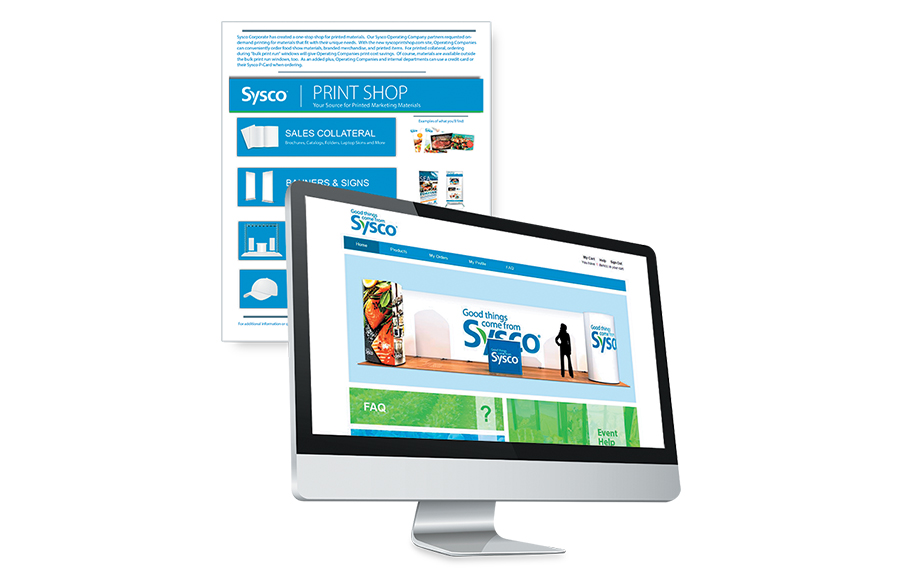
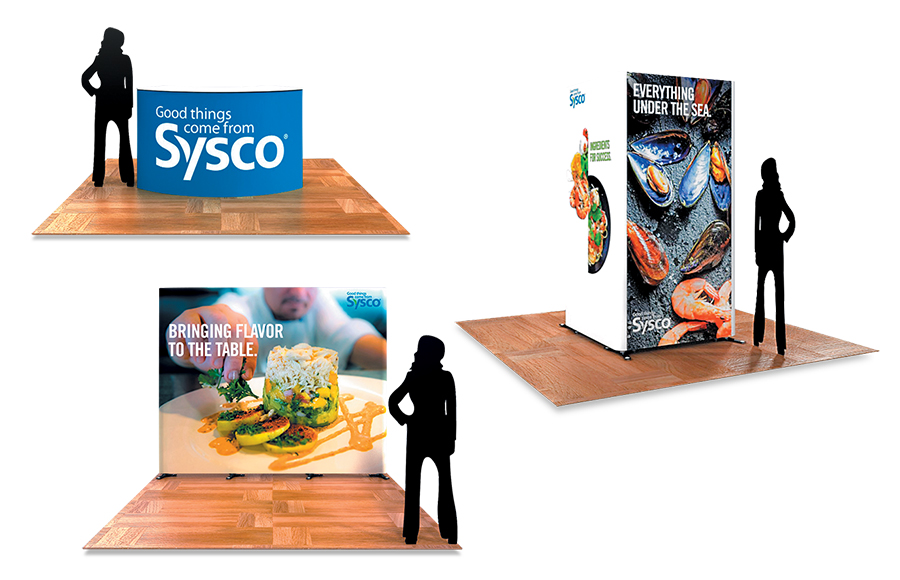
Goetz's next strategy was enlisting Betsy Earle, CTSM, owner of Clearwater, FL-based Event Driven Solutions LLC, who was tasked with evaluating Sysco's exhibit consistency conundrums and providing a uniform solution. After studying how Sysco engaged with its customers in its exhibits, Earle developed a template using Triga Systems components that could be customized to accommodate a variety of footprints and configurations for Sysco's exhibits at smaller trade shows. Earle also supervised the creation of an online portal called the Sysco Toolbox to serve as a sort of trade show storefront and event-planning guide for exhibit managers. The portal allows exhibit managers to enter the parameters of an event or trade show (e.g., location, booth size, number of expected prospects, etc.) and be given a recommended Triga configuration and list of vetted vendors. Exhibit managers can then order their desired components and have them shipped to the venue.
Exhibit graphics were also given a consistent look via Sysco's longtime marketing agency, the Houston-based Adcetera Design Corp. Graphics were previously produced by the individual operating companies, which resulted in conflicting visual messages from show to show. By centralizing the design process and making the resulting graphics available on the online portal, Goetz ensured that Sysco's exhibits would maintain a recognizable look for any variety of markets nationwide, from seafood-focused shows in the Northeast to beef-centric expos in Texas.

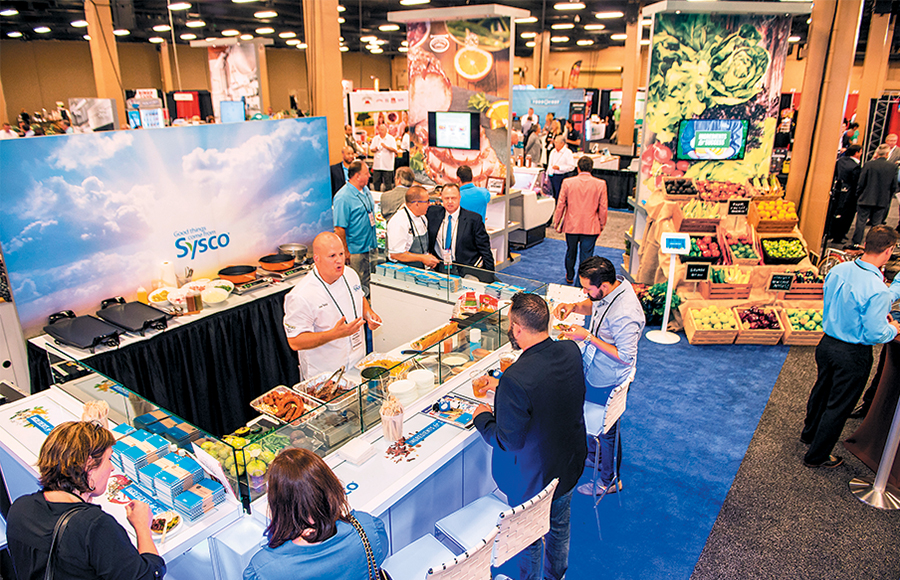
"Culinary is at the heart of what we do. As such, we wanted to showcase our passion in the design of our trade show kitchen," Goetz says. So Earle partnered with Skyline Exhibits to completely redesign Sysco's kitchen with modular, top-of-the-line appliances and workstations, improved lighting, and a media suite of cameras and LED screens to better spotlight the culinary delights being whipped up by Sysco's corporate chefs. The redesigned kitchen would then serve as an interactive exhibit element, as well as an on-brand focal point.
Like the Triga components and standardized graphics, a number of the new kitchen elements were added to the Sysco Toolbox and made available to all of the operating companies, an enormous time-saver for exhibit managers and a way for Sysco to balance national brand uniformity with the regional autonomy that is one of its biggest strengths. "By using the trade show storefront, we've offered our 98 operating companies choice and flexibility while keeping our messages consistent," Goetz says. "Each operating company is able to purchase the display configuration it desires and select from graphics that fit our national trade show messaging."
A Fresh Take
After addressing Sysco's consistency issues, Goetz focused on improving attendees' at-show experience along with the company's lead management process. At most shows, attendees came to Sysco's exhibit to see what was new, enjoy a bite or two of what the chef was creating in the kitchen, possibly place an order, and then be on their way. The emphasis was on the product itself, not the story behind the product (i.e., sustainability, freshness, and local sourcing) nor how it could benefit attendees' businesses. Goetz realized that Sysco had a virtual army of some of the top food buyers and merchandisers in the world. So why not make them a part of the in-booth experience?
A companywide initiative was created to bring these experts to Sysco's exhibits and directly tie their expertise to what was happening in the show kitchen. For example, if Sysco's corporate chefs were serving up poke nachos, members of the company's seafood buying team would also be on site to discuss how the fish is sourced, how much Sysco committed to buy, and pricing forecasts. "These teams are knowledgeable and up-to-date in terms of food safety and traceability, which are huge trends in the marketplace," Goetz says. "If a foodie wants to know what the lobster catch will be in the fall, there is an expert on hand. But that same team of experts can also speak to the weight of grade A beef and the safety of Asian shrimp." Hand in hand with this initiative came a renewed focus on Sysco's consultative approach to selling. "In the past, we were focused on promoting ingredients," Goetz says. "The shift came in thinking about moving beyond the products we sell to what these products can do for our customers' businesses. Everything is about supporting the restaurateur's success." So now when a customer with a steakhouse comes to Sysco's exhibit, staffers don't just extol the freshness and quality of Sysco's beef, but work with the restaurateur to uncover ways to incorporate the protein into his or her menu in innovative ways.
As soon as a targeted attendee arrives at Sysco's booth and has his or her badge scanned, the show manager or the attendee's sales rep receives an email or text alert. And since the Lead Capture system already gathered that the attendee is interested in gluten-free entrees, staffers can approach the in-booth kitchen and ask the chef to prepare the appropriate dishes. By the time the attendee is scheduled to meet with his or her rep, the rep is ready and waiting, gluten-free morsels in hand.
While this execution seems almost balletic in its orchestration, Lead Capture is all about data collection, including which customers came to the show, who interacted with them, who should follow up with them, and when they'll be ready to place their orders. "Now that we have the technology to scan badges and collect our own leads, we can interact with customers as their interests direct," Goetz says. Exhibit managers at a national event like the NRA Show can even monitor if a customer received follow-up on a certain date and placed an order with their local sales rep.
Food for Thought
By centralizing Sysco's fractured trade show and event program, Goetz delivered more than unified messaging and cohesive exhibit elements. Since debuting the revitalized program in 2015, Sysco's number of show impressions, which the company defines as unique badge scans, has grown by a cumulative rate of almost 240 percent. And in the past three years, Sysco's surveys indicate post-show purchase intent and positive brand impressions have increased by 20 percent and 35 percent, respectively.
Goetz's innovative tactics left an even more positive impression on All-Star Awards judges, who praised his creation of the Sysco Toolbox online portal, as well as his strategy for unifying Sysco's trade show branding. "Bill is a great example of how recognizing an opportunity, establishing a vision, and utilizing strong collaboration to come up with an exhibit-marketing message can produce measurable brand perception results," one judge said.
According to culinary icon James Beard, "Food is our common ground, a universal experience." By weaving a common thread through his company's exhibit programs and ensuring that attendees have an in-booth experience that is universal in quality if not in content, Goetz proved that Sysco is absolutely capable of bringing more to the table – and doing so with undeniable consistency. E


Marketplace

- Audiovisual Equipment
- Convention Centers
- Event Design and Production
- Exhibit Fabrication
- Exhibit Producers
- Exhibit Rental
- Experiential Agency
- Flooring
- Graphics
- International Exhibit Producers
- Kiosks
- Lead Retrieval
- Modular Exhibit Systems
- Portable Display Systems
- Shipping and Transportation
- All Companies
3048R Sales and Marketing Alignment: How to Get ‑ and Stay ‑ on the Same Page
Feb. 10, 2026
3011R How to Grow Your Brand: Incorporating Brand Marketing into Your Exhibit Program
Feb. 19, 2026
4101R Boost Up: Promote Yourself from Service Provider to Strategic Business Partner
Mar. 3, 2026
6020R The @show Experience: Understand the Essentials of Exhibit Design
Mar. 10, 2026
7058R Authors Executive Series: Thrive Under Deadlines: Strategies for Success
All Sessions >>