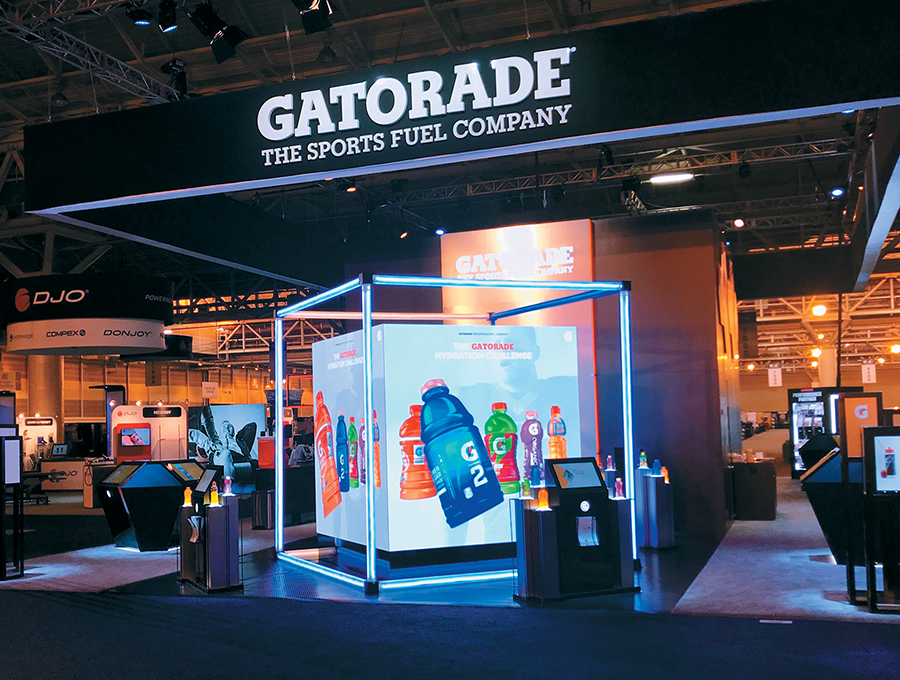
Show: National Athletic Trainers' Association Clinical Symposia and AT Expo (NATA)
Size: 40-by-70 feet
Challenge: After watching its market share dip from 93 percent to roughly 75 percent, Gatorade needed to regain momentum.
Solution: Focusing on athletic trainers and sports-medicine professionals, Gatorade staged a traffic-building trifecta of gamified engagements, educational product displays, and multimedia magic to draw a critical mass of attendees and thereby help re-establish its products' dominance.
On one front, some consumers were slowly shying away from Gatorade due to concerns over the abundant salt and sugar the drink contained. Secondly, competitors ranging from The Coca-Cola Co. to Abbott Laboratories Inc. had swaggered into the $23 billion sports-drink arena with numerous products designed to shove Gatorade off its enviable perch. What's more, many of Gatorade's rivals boasted slightly fewer carbs and less sugar along with substantially more vitamins, which allowed those alternatives to be perceived as healthier choices.
Thirst Aid
Gatorade's immediate problem, then, was to stem the attrition and achieve some marketing momentum to regain its crushing lead. After a careful assessment of its situation, the company concluded it should focus even more on sports influencers and amateur athletes who typically work out 365 days a year come hell or high water and who, much more than the casual consumer, welcome the energy boost provided by Gatorade's cocktail of sugary carbohydrates and salty electrolytes to refuel their strained bodies.
But the evolution in strategy begged the question: How could the company most effectively and efficiently reach that precise demographic? One part of the answer was a show at which Gatorade often exhibited: the National Athletic Trainers' Association Clinical Symposia and AT Expo (NATA), which is purportedly the world's largest trade show dedicated to sports medicine. NATA attracted a sizeable segment of the athletic trainers and sports-medicine professionals Gatorade was targeting. And by the very nature of their jobs, these attendees were influencers who could recommend products to their clientele of athletes, patients, students, etc. For Gatorade, this would not be a wildly new approach to exhibiting at NATA, but rather a pivot to focusing more on product innovation and the resources the company provides.
So to create draws that would quench attendees' key needs and interests, Gatorade worked with exhibit house MSM Inc. on a strategy comprising a few core ingredients: games to play on attendees' intrinsic competitiveness (and place product benefits in a favorable context), educational presentations on sports- and health-related topics to appeal to guests' medical backgrounds, product displays to keep visitors up to date on the latest advances from the company, and user-generated content to drive engagement.

Last, Gatorade set a goal of drawing in approximately 70 percent of NATA attendees. Such a number, the company reasoned, would increase the chance of creating a critical mass of evangelists that would spread the Gatorade gospel far and wide.
Drinking Games
When NATA opened at the Ernest N. Morial Convention Center in New Orleans, attendees received their RFID bracelets – dubbed G Bands – near show registration and were instructed to register the devices on a mobile website. After donning and activating the bands, guests beelined toward Gatorade's exhibit and often started at the hard-to-miss HydroCube, a massive gaming station where four pairs of visitors at a time could compete in head-to-head challenges. "Battle Stations," i.e., 22-inch LED touchscreens mounted near RFID sensors, on each of the structure's four sides displayed images of athletes such as star NFL quarterbacks. Once players initiated a game by swiping their G Bands over the sensor, the quarterback would, for example, sling a football. But before he could complete his forward pass, the screen froze and flashed a hydration-related trivia question. The two contestants then had just 20 seconds to respond.
If players answered incorrectly, the attempted pass failed. If they got the question right, the pass succeeded, and players won a point. The more points players won, the more prizes they walked away with. Scores of ultra-competitive visitors vied to rack up points and carry away athletic swag, such as bottles of Gatorade and branded shoelaces.
After duking it out at the HydroCube, attendees moved on to the less competitive but equally engaging Social Cubes. Two sides of the structures housed 85-inch touchscreens that presented a dynamically changing mosaic of 12 athletic trainers' faces. Press on a given face, and that trainer's personal story would flow out over the screen in text form. In essence, the attraction allowed guests to discover others like themselves: athletes who had moved into training, healing, and coaching other athletes.
Gatorade then took things a step further and transformed the Social Cubes activity from essentially passive to decidedly active by celebrating the guests themselves. On the sides of the cubes adjacent to the touchscreens was a related activation involving a pair of photo stations. Prompted by staffers, visitors could activate any of the photo stations by holding their G Bands close to them. As the devices flared to life, users snapped photos of themselves and added one of six graphic filters to the images. On-screen prompts then encouraged them to respond to one of several statements, including "I am motivated by," after which their written answers were worked in as text accompanying their images. With the press of a button, participants submitted their entries to the original feed of trainer profiles on the nearby touchscreens, as well as sent digital versions to their own emails. Countless guests paged through the mini biographies on the Social Cubes, which effectively became a crowd-sourced socializing tool that capitalized on attendees' desire to learn more about others who shared their passions.

By monitoring attendees via its G Bands, Gatorade could track not only where booth visitors spent their time but also which activations generated the most interest. This helped continue its data-driven strategies to improve upcoming exhibits.

Next up were the 360 Pods, which consisted of five four-sided structures. Custom touchscreens on each side offered attendees 360-degree views of Gatorade Performance Partners' newest facilities, such as the American College of Sports Medicine and the National Strength and Conditioning Association Performance Center. Hotspots in the videos brought up details about the facilities and activated interviews with key sports-health practitioners from the partner groups. Attendees could also email themselves information they found useful directly from the pods. The explicit purpose of the pods was to supply attendees with a variety of resources that would be of professional benefit to them, while the more subtle aim was for participants to note Gatorade's links to these august scientific institutions and associate their rigorous health and wellness efforts with the brand itself.
Even here, Gatorade shrewdly played to attendees' deep-seated desire to compete. The more information guests consumed, the more points they were conferred via their G Bands, resulting in more prizes similar to those won at the HydroCube.
Topping off their visits, guests moved from the 360 Pods to the five Innovation Towers, each of which comprised a vertical structure outfitted with a transparent OLED screen.
Gatorade positioned physical products, such as its Endurance Formula and G Organic drinks, behind the OLEDs, which displayed facts and information about the beverages in a dazzling mixed-reality concoction. With the items seeming to float in space within a sea of data, attendees enjoyed a visually appealing display of basic info about the company's offerings – such as carbohydrate levels, calorie counts, and proven benefits – instead of the often dry data exhibitors supply through bored staffers or lackluster visual elements.
Once NATA attendees wrapped up their visits, they checked out with staffers, collected the prizes they won in the various activations, and were informed they could keep their G Bands as a mementos. But even after they departed, visitors remained in the form of lingering digital trails Gatorade could – and would – examine, such as if a particular guest attended a lecture on hydration or spent time at the Innovation Tower highlighting the Organic G beverage.
Liquid Assets
Heading into NATA, Gatorade's goal was to draw a percentage of attendees equal to what it attracted at the previous year's show. And by the expo's conclusion, the company had pulled in 4,140 visitors, representing the hoped-for 70 percent of showgoers. Of course, only time will tell if the exhibit helped increase the company's market share. For the more immediate future, though, the collected RFID data allowed the company to plan its future exhibits with genuine insight into what resonates most with visitors. For example, records showed that a large portion of attendees favored nonproduct-related activities such as the HydroCube and Social Cubes.
As a result of its high-tech visitor tracking, competitive games, objective education, user-generated content, and mixed-reality product displays, Gatorade slaked its thirst for a more effective exhibiting program. In other words, by tapping into the power of face-to-face marketing, the company captured the kind of lightning in a bottle that might make its market-share cup overflow once again.E


Marketplace

- Audiovisual Equipment
- Convention Centers
- Event Design and Production
- Exhibit Fabrication
- Exhibit Producers
- Exhibit Rental
- Experiential Agency
- Flooring
- Graphics
- International Exhibit Producers
- Kiosks
- Lead Retrieval
- Modular Exhibit Systems
- Portable Display Systems
- Shipping and Transportation
- All Companies
3048R Sales and Marketing Alignment: How to Get ‑ and Stay ‑ on the Same Page
Feb. 10, 2026
3011R How to Grow Your Brand: Incorporating Brand Marketing into Your Exhibit Program
Feb. 19, 2026
4101R Boost Up: Promote Yourself from Service Provider to Strategic Business Partner
Mar. 3, 2026
6020R The @show Experience: Understand the Essentials of Exhibit Design
Mar. 10, 2026
7058R Authors Executive Series: Thrive Under Deadlines: Strategies for Success
All Sessions >>