
Accounts differ as to the date, but according to historian Scott M. Cutlip, one day in 1918 Schwab – in his quest to increase the efficiency of his team and discover better ways to get things done – arranged a meeting with a highly respected productivity consultant named Ivy Lee. Lee was a successful businessman in his own right and is remembered as a pioneer in the field of public relations.
As the story goes, Schwab asked Lee into his office and said, "Show me a way to get more things done." Lee said he needed just a 15-minute meeting with each of Schwab's executives. "How much will it cost me?" Schwab asked. "Nothing," Lee said. "Unless it works. After three months, you can send a check for whatever you feel it's worth to you."
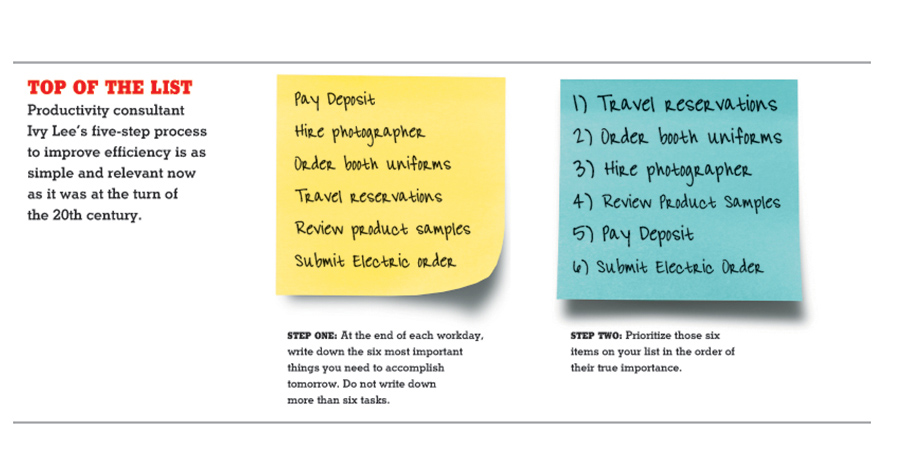
During his 15 minutes with each Bethlehem executive, Lee explained his method for achieving peak productivity:
Step 1: At the end of each workday, write down the six most important things you need to accomplish tomorrow. Do not write down more than six tasks.Step 2: Prioritize the six items on your list in the order of their true importance.
Step 3: When you arrive the next morning, concentrate only on the first task. Work until the first task is finished before moving on to the second task.
Step 4: Approach the rest of your list in the same fashion. At the end of the day, move any unfinished items to a new list of six tasks for the following day.
Step 5: Repeat this process every working day.
Lee's strategy sounded simple, but Schwab and his executive team gave it a try. After three months, Schwab was so delighted with the progress his company had made that he called Lee into his office and wrote him a check for $25,000, the equivalent of $400,000 today.
It's simple enough to actually work.
A primary critique of methods like this one is that they are too basic. After all, they can't possibly account for all of the complexities and nuances of an exhibit manager's day-to-day life. What happens if a new show is added to your calendar at the very last minute? What if your exhibit is lost in transit, and you have to execute a contingency plan? Yes, emergencies will arise. Ignore them as much as possible, deal with them when you must, and get back to your prioritized to-do list as quickly as you can. Use simple rules to guide complex behavior.
It forces you to make tough decisions.
I don't believe there's anything magical about Lee's number of six important tasks per day. It could just as easily be five tasks per day. However, I do think there is something magical about imposing limits upon yourself. I find that the single best thing to do when you have too many tasks (or when you're overwhelmed by everything you need to get done for an upcoming trade show) is to prune your ideas and trim away everything that isn't absolutely necessary. Constraints can make you better. Lee's method is similar to Warren Buffett's rule that requires you to focus on just five critical tasks and ignore everything else. Basically, if you commit to nothing, you'll be distracted by everything.
It removes the friction of starting.
The biggest hurdle to finishing most tasks is starting them. (Getting off the couch can be tough, but once you actually start running, it is much easier to finish your workout.) Lee's method forces you to decide on your first task the night before you go to work. For example, if you're preparing for a show and the discount deadline is creeping up on you, you may want to write "order show services" down as priority No. 1 for the next day. Then, rather than settling into your office the following morning and checking your email, which is likely full of distractions and other action items that are less time sensitive, you can sit down and start completing those order forms.

It requires you to single-task.
I get it. Exhibitors love multitasking, and they're proud of their ability to juggle so many balls at once. But the myth of multitasking is that being busy is synonymous with being better. The exact opposite is true. Having fewer priorities leads to better work. Study world-class experts in any field (athletes, artists, scientists, CEOs), and you'll discover one characteristic that runs through all of them: focus. You can't be great at one task if you're always dividing your time 10 different ways – and you cannot efficiently accomplish anything when your attention is constantly shifting. Yes, exhibit managers are known for being jacks of all trades, but true mastery requires focus and consistency.
Now I know what you're thinking as you consider the multitude and magnitude of the projects on your plate: Will this really work? Is it possible to focus on just six tasks per day when I'm used to putting out 50 exhibit-related brush fires every afternoon? It's worth a shot. Ultimately, if you find that Lee's five-step, six-task approach isn't applicable to your role as a face-to-face marketer, try applying this singular and very basic rule: Start each day by completing the most important thing on your to-do list before tackling anything else. You'll be amazed at how quickly you can power through your priorities when you focus on what's most important first. E
 James Clear writes about behavioral psychology, habit formation, and performance improvement on his website, www.JamesClear.com. His work has been covered by dozens of major media outlets including Time Magazine, Entrepreneur, Forbes, and more.


Marketplace

- Audiovisual Equipment
- Convention Centers
- Event Design and Production
- Exhibit Fabrication
- Exhibit Producers
- Exhibit Rental
- Experiential Agency
- Flooring
- Graphics
- International Exhibit Producers
- Kiosks
- Lead Retrieval
- Modular Exhibit Systems
- Portable Display Systems
- Shipping and Transportation
- All Companies
3048R Sales and Marketing Alignment: How to Get ‑ and Stay ‑ on the Same Page
Feb. 10, 2026
3011R How to Grow Your Brand: Incorporating Brand Marketing into Your Exhibit Program
Feb. 19, 2026
4101R Boost Up: Promote Yourself from Service Provider to Strategic Business Partner
Mar. 3, 2026
6020R The @show Experience: Understand the Essentials of Exhibit Design
Mar. 10, 2026
7058R Authors Executive Series: Thrive Under Deadlines: Strategies for Success
All Sessions >>