Company: Bell Canada
Event: Bell Box
Objectives: Expose current and prospective customers, especially Millennials, to Bell Canada's new line of products.
Strategy: Sponsor a popular music festival and draw in Millennials by tapping their deep craving for exotic experiences with avant-garde architecture.
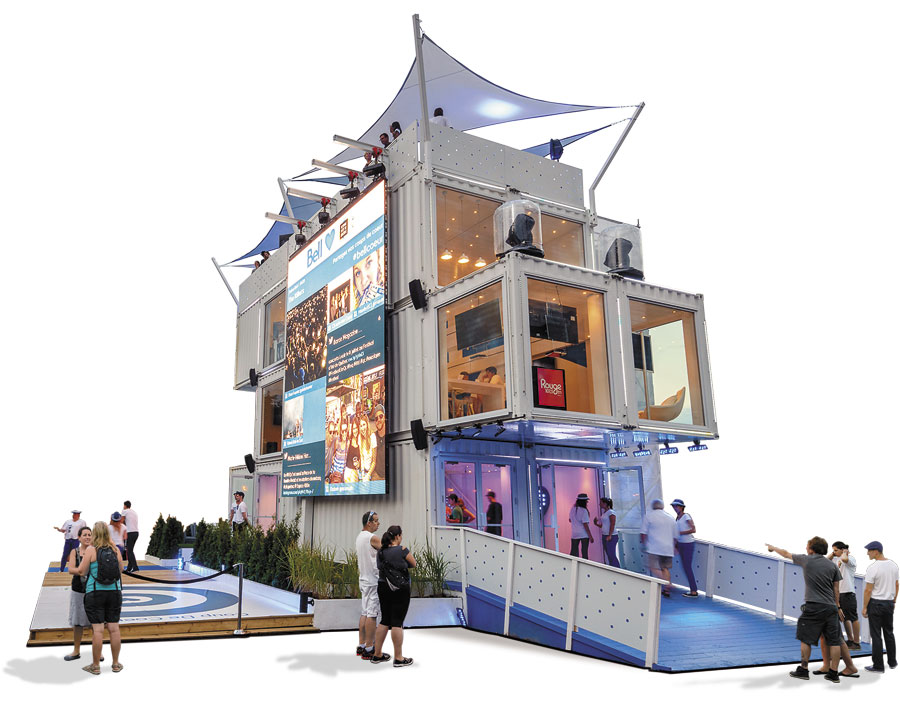
Tactics: Construct an unconventional pavilion made of six repurposed shipping containers at the FrancoFolies French Music Festival. Offer extensive product demonstrations of Bell's high-speed telephony/TV/Internet services.
Results: Exposed more than 1 million attendees to the Bell brand. Spurred a 30-percent jump in visitors and doubled sales from the previous year.
Creative/Production Agency: Loki Box Design, www.lokiboxdesign.com
Budget: $750,000 – $999,000
Nearly 140 years after the telephone debuted at Philadelphia's Centennial International Exhibition of 1876, telecom companies like Bell Canada are still creating innovative ways to lure customers and win their share of what the Telecommunications Industry Association estimates is a $5.6 trillion market. Based in Montreal, Bell Canada ranks No. 289 on Forbes Global 2000 list of the world's largest public companies, supplying mobile voice, data, and broadband Internet services to roughly 7 million customers. But for all its marketplace magnitude, Bell needed to broaden its appeal, especially to Millennials. It's easy to see why: According to Deloitte Touche Tohmatsu Ltd., North American Millennials spend up to $1,500 a year for telecom services, more than any other generation.
Calling Plan
Over the last 30 years, the Canadian telecom's marketing strategy included sponsorships of nearly 100 cultural events to reach out and touch its various audiences, such as the prestigious Montreal International Jazz Festival and the FrancoFolies French Music Festival (aka Francos). Those sponsorships were a safe bet for Bell, considering that Nielsen Holdings N.V.'s Music 360 report found that 76 percent of music-festival attendees reported feeling more favorable toward brands that sponsored a concert.
After mulling over the marketing-to-Millennials challenge, Bell concluded that it should continue to sponsor the festival-based events it had previously. After all, according to research from Eventbrite, a stunning 20 percent of Millennials attended a music festival in the past year. "Millennials are the most event-driven generation of customers today. We've seen them quit a job to go to a concert or take a vacation," Dorsey says. "Events are the touchstone of a generation that defines itself more by experiences than purchases." But rather than simply maintaining its sponsorship status quo, Bell chose to up the ante with a physical element that would appeal to all age brackets, especially Millennials. Thus, the company decided to first be the sole or lead sponsor of three particular festivals: the Francos, the Quebec City Summer Festival, and the Toronto International Film Festival, which would occur from June to September 2014 and attract roughly 3 million visitors.
Bell's next step was to blueprint a cutting-edge pavilion that would be as captivating in style as it was colossal in square footage. Its arresting architecture needed to draw thousands of attendees and offer more of the exotic experience Millennials crave. Once inside, they could explore and purchase products and services from the company's main lines, e.g., telephony, television, and Internet. Moreover, Bell hoped attendees would gather at the pavilion as a sort of informational watering hole, to share news face to face and via social media about the fest and, by association, the sponsor. With luck, these strategic elements would form a template that Bell could use for two additional events that it planned to sponsor following the Francos.
While Bell had an architectural ambitiousness that was nearly pharaonic, its goals for the pavilion were conversely modest. It would count people who came in the pavilion and explored the product areas, and it would tally on-site sales of its services. Bell wanted the number of attendee engagements to jump almost 15 percent compared to 2013 metrics from the Francos. On-site sales were of secondary importance to Bell, but the company hoped for an equal increase of 15 percent.

Once the strategy, venues, and goals were finalized, Bell teamed up with Loki Box Design to push ahead with its vision of a structural focal point for events that would function as much as a beacon-like landmark as a home-base hub for interactions between Bell booth staffers and event attendees. Based in Stoneham, QC, Canada, Loki acquires old shipping containers that have been retired after 20 years or more circumnavigating the globe on cargo ships, and from these marine castoffs builds trade show booths and exhibiting spaces with the charm of oversized Lego blocks. Bell had used single shipping containers to create booths for several years at previous festivals, and was intrigued with the idea of using them in a bigger, bolder way.
Now, however, Bell would construct an immense event space of stunning postmodern glamor. "It would be a canvas for expressing Bell's brand," says Pierre-Mathieu Roy, Loki's president and creative director. "Tents, which you commonly see used at these festivals, simply can't compete with something like this."
When the Francos opened in June of last year, Bell's strategy unfolded with the sublime elegance of an origami sculpture. The 1,000 acts appearing on seven outdoor stages might almost have been a mere opening act for the Bell pavilion, which the company nicknamed The Box. Made of six 40-by-8-by-9-foot steel shipping containers, The Box was arranged in a manner reminiscent of Jenga: The stacked containers soared 40 feet high, with three levels, and a rooftop deck for VIP entertaining. Fifteen 8-by-8-foot windows filled The Box with light during the day, but when dusk fell, 80, 6-foot-long LED strips set inside and outside the structure pulsed at times like a heartbeat, and cascaded at other moments with lollipop-colored blocks.

On the second level, 15 screens ranging from 32 to 78 inches displayed Bell-branded content, fest info, and more technology tips for the festival goers. With some of the nearly 30 staffers in branded polo shirts assisting them, guests could, for example, check out Bell's Fibe TV service on a curved 78-inch 4K screen, experimenting with its HD digital video-recording capability and on-demand programming as well as the Bell TV remote application that lets customers control their televisions straight from their smartphones.
One more flight up, guests saw the control center for the pavilion's giant exterior screen: a branded 27-by-20-foot LED monitor facing an enormous plaza of food tents and picnic benches. From inside the aerie, attendees watched Bell staff stream concert updates, news of celebrity sightings, and a live feed of selected performances to the towering screen that wouldn't have looked out of place in New York's Times Square. More importantly, Bell staffers sifted through an ocean of social-media posts from attendees, and selected samples to display on the screen. Outside, attendees gathered in droves to watch the flow of tweets and posts, often photographing the massive monitor and passing on their pics and comments to Instagram, Pinterest, Twitter, and Facebook, creating a perpetual motion of social-media activity.

True Calling
All fest long, attendees barreled into the unique pavilion as if they had been fired out of a cannon. In fact, nearly 1,500 a day visited The Box, an Olympic-worthy jump of nearly 30 percent over Bell's previous appearance at the Francos – and almost double its goal for the event. On-site sales followed an equally satellite-high trajectory, increasing 30 percent, again, twice the company's goal.
In tandem with the attractions inside the pavilion, the giant screen helped turn The Box into ground zero for thousands of attendees to flock together. Furthermore, Bell's template for the Francos worked so well that the company employed it not just for the other two events it sponsored that summer, but for several more after it.
Bell drew thousands because it provided the experience Millennials craved. Accordingly, Corporate Event Awards judges heaped laurels on The Box, hailing it as "aesthetically pleasing" and "beautifully done." But perhaps one judge said it best, saying only, "I want to live there." E


Marketplace

- Audiovisual Equipment
- Convention Centers
- Event Design and Production
- Exhibit Fabrication
- Exhibit Producers
- Exhibit Rental
- Experiential Agency
- Flooring
- Graphics
- International Exhibit Producers
- Kiosks
- Lead Retrieval
- Modular Exhibit Systems
- Portable Display Systems
- Shipping and Transportation
- All Companies
3048R Sales and Marketing Alignment: How to Get ‑ and Stay ‑ on the Same Page
Feb. 10, 2026
3011R How to Grow Your Brand: Incorporating Brand Marketing into Your Exhibit Program
Feb. 19, 2026
4101R Boost Up: Promote Yourself from Service Provider to Strategic Business Partner
Mar. 3, 2026
6020R The @show Experience: Understand the Essentials of Exhibit Design
Mar. 10, 2026
7058R Authors Executive Series: Thrive Under Deadlines: Strategies for Success
All Sessions >>