international |
|||||||||||||||||||||||||
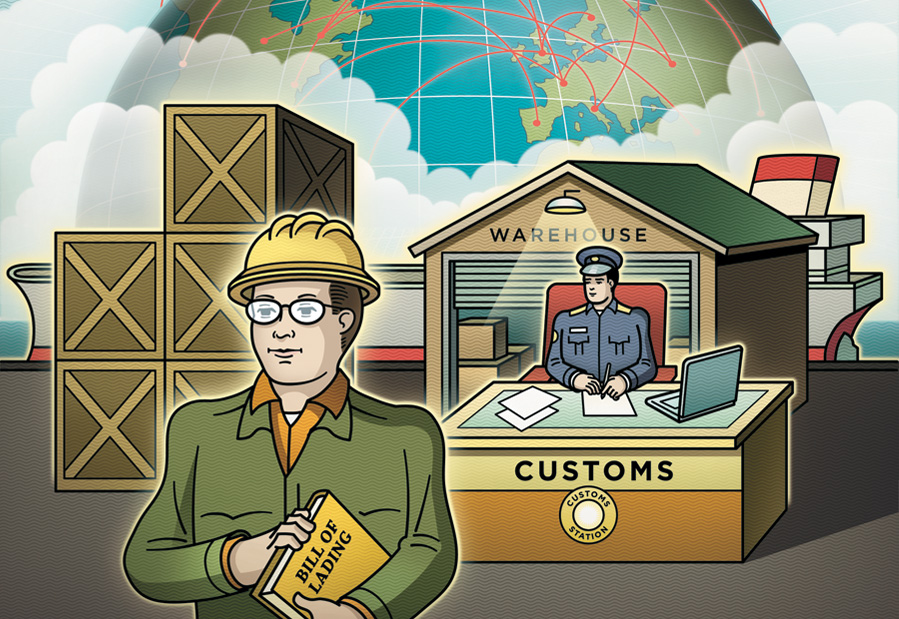 ILLUSTRATIONs: PETER AND MARIA HOEY
Customs, Crates & Carnets
A Global Guide to International Shipping
By Cynthya Porter  n the global trade show market, the United States is but a blip on the exhibition radar, with markets around the world dwarfing the U.S. exhibiting industry in terms of both the number of shows scheduled and the sheer size of the events taking place. With an eye toward the growing global marketplace, many U.S. companies view those shows as the proverbial pot of gold at the end of the rainbow, promising unimaginable wealth for those who find it. And while it may be true that those distant locales are spilling with riches for a trade show program, international shipping done badly will make reaching those destinations every bit as difficult as finding the end of the rainbow in leprechaun lore. n the global trade show market, the United States is but a blip on the exhibition radar, with markets around the world dwarfing the U.S. exhibiting industry in terms of both the number of shows scheduled and the sheer size of the events taking place. With an eye toward the growing global marketplace, many U.S. companies view those shows as the proverbial pot of gold at the end of the rainbow, promising unimaginable wealth for those who find it. And while it may be true that those distant locales are spilling with riches for a trade show program, international shipping done badly will make reaching those destinations every bit as difficult as finding the end of the rainbow in leprechaun lore. When shipping to a U.S. destination, trade show managers need to do little more than pack up their items, create a bill of lading, mark some crates, and call a shipping company to move the goods. International shipping, on the other hand, requires dozens more steps and contains a wide swath of landmines exhibitors must navigate lest they blow their global exhibiting plans out of the water. Here, then, are some tips collected from international shipping experts to help exhibit managers chart a course that will get their freight to overseas shows on time and intact — and without having to pour money into that pot of gold rather than take some from it. 
All other things being equal, it seems that the obvious benefit of sending by air is speed, while the drawback is the added expense. This, however, is not always the case. According to Greg Keh, executive vice president of TWI Group Inc., ocean freight is most often charged based on container size with less emphasis on weight, and shipments that are large and heavy are usually much cheaper to send as ocean cargo. Airfreight costs are typically calculated using a formula of weight combined with size, making it a more costly option for bulky, heavy shipments. But sending freight weighing less than 1,000 pounds can sometimes be cheaper by air, depending on the amount of volume it requires.
It's also worth noting that airfreight can reach more cities than ocean freight, and exhibitors must factor in the time and cost for ground transportation to an international city if the cargo vessel can't sail directly there. But when calculating days needed for transport before a trade show, be careful not to confuse actual transit time with how much time it will take for your cargo to reach the venue. That's because every shipment that arrives must go through a customs-clearance process that will add days or even weeks to the timeline, and sometimes more. Therefore, the total amount of time your shipment will spend in transit from point A to point B depends entirely on the destination and whether you have followed the paperwork guidelines for importing goods.
Palletizing and shrinkwrapping freight can be problematic for international shipments. The plastic may need to be removed to stack items in a shipping container or so customs officials can open crates, and what is left is a loose pile of boxes that may not be suitably prepared to be shipped on their own. Bruno advises clients with pallets to write a bill of lading for the shipment that lists both how many pallets are in the shipment and how many total pieces those pallets contain (e.g., seven pallets, containing 135 pieces).
Customs officials may drill holes in crates to view contents or open and examine each crate, so use shipping crates designed to open and close easily. The rigorousness of the customs process depends heavily on the items you list on your packing slip and the country you are entering, but regardless of the destination, having containers that are not easy to access can result in damaged crates. Also, Lorenzini says, package and inventory items that are for permanent import (collateral, tchotchkes, etc.) separately from things that fall under a temporary import classification (exhibit components, demo equipment, etc.), which will leave the country following the show. If you don't do this, the customs-clearance process will take longer.
According to Tom Grell, communications specialist at Gomaco Corp., you might need to provide the serial numbers for electronics (and the Federal Communications Commission [FCC] identification number for laser products like DVD players) as well as a value for each article in your shipment. In addition, numerous countries want certificates of origin for items stating where they were manufactured, and, depending on the country, this could be for your entire shipment or only for certain types of products. Some countries accept a certificate of origin created by you on company letterhead, though some require a document notarized by a U.S. chamber of commerce. In some instances, customs officials will expect the certificate to be from the manufacturers of the products themselves. For items that will not be sold, exhibitors must still provide a fair market value for them, and in some countries, this extends down to the value of the paper the documents are printed on. Christopher Dorn, president of Idea International Inc., cautions exhibitors to provide accurate values for articles, because if customs officials think you have underestimated their value, they may hold the shipment until an independent, third-party broker assesses the items. In addition, descriptions must be thorough, such as "Boxed desk set containing pencil, day planner, and pen" rather than calling it a "desk set" on the inventory. Dorn also suggests that your shipment includes photos of the items in it and descriptions of what the items are and what they do.
Be aware that there are items that can't be sent into some countries, even temporarily. This can apply to giveaway items manufactured in a country unfriendly with the destination country, food, materials deemed offensive by customs agents, or any of a wide variety of other products. When in doubt, purchase the items once you get to your destination. The United States has a corresponding set of numerical codes (the HS code plus four additional digits) called Schedule B numbers for tracking exports from the country, and these may also need to be documented on items not classified as a temporary export. And, reminds Phil Olsen, warehouse and logistics manager at Orbus Co., anything you plan to bring back to the United States will need a whole separate set of import documents and arrangements for its return trip, because often the importer and exporter for your shipment are different companies. Among the documents you need for temporary exports is a customs certificate of registration, which typically accompanies a temporary import bond (prepared for the destination country) unless you are using an ATA Carnet, which is explained in the next section. Shipments may also need to be accompanied by a variety of other forms including a shippers export declaration or electronic export information filing (EEI) if the value of any single item exceeds $2,500.
For all shipping and customs documentation, make several copies of each form to send with the shipment, and don't forget to include the value of that stack of paper on the inventory. Exhibitors should not underestimate how seriously customs officials take these regulations, or the amount of time needed on the front end to prepare documents well. According to UPS, more shipments are held up in customs due to an inaccurate description of goods than for any other reason.
 ATA Carnets ATA CarnetsAn ATA Carnet, also known as a "merchandise passport," is the gold standard for temporarily importing items into another country.  It is an international customs document facilitated by the World Customs Organization and the International Chamber of Commerce to reduce barriers in global trade, and it is accepted by 80 countries and territories worldwide. Verla Williams, marketing coordinator at Schneller LLC, notes that an ATA Carnet not only facilitates imports, but can also save an exhibitor some serious money. It is an international customs document facilitated by the World Customs Organization and the International Chamber of Commerce to reduce barriers in global trade, and it is accepted by 80 countries and territories worldwide. Verla Williams, marketing coordinator at Schneller LLC, notes that an ATA Carnet not only facilitates imports, but can also save an exhibitor some serious money. An ATA Carnet is used only with items being shipped internationally that will return to the United States, making it a perfect tool for the trade show industry. Exhibitors can register items such as exhibit properties, demo equipment, professional tools, personal goods, and product displays on an ATA Carnet. Articles registered on an ATA Carnet, Bruno says, are not subject to VAT or other import duties, and they're eligible for unlimited international entries and departures for up to one year using the same document. Moreover, an ATA Carnet can eliminate the need for several other international shipping forms, including electronic export information forms, temporary importation bond forms, and the customs certificate of registration for re-entry to the United States. ATA Carnets can be obtained from either one of two officially appointed ATA Carnet service providers: Roanoke Trade Services and Boomerang Carnets. Using one of these outlets, a company can submit an itemization of everything being shipped internationally that will return to the United States and purchase an ATA Carnet document that acts as a guarantee to foreign governments that the items and materials will only be in that country temporarily. According to documents published by the United States Council for International Business (USCIB), ATA Carnets should not be used for consumable products or items that may be sold while in a foreign country, as anything missing from the returning shipment will prompt a hefty fee plus a calculation for customs fees and VAT on top of it.
Fees for securing an ATA Carnet vary depending on the value of the freight, ranging from $225 for shipments valued under $10,000 to $380 for shipments valued at more than $250,000. Additional certificate sets, forms listing more than 50 items, rush delivery, and other services carry nominal additional fees, but the real upfront expense of an ATA Carnet is that a company must submit a security deposit equaling 40 percent of the value of the general list, or purchase a surety bond from one of the 200 companies authorized by the U.S. Treasury Department. As the cost of a bond is usually 1 percent of the shipment's value, virtually all ATA Carnet applicants post a bond.
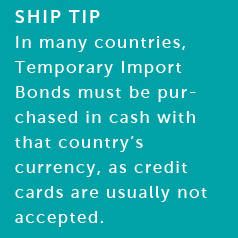
Temporary Import Bonds (TIB)Export.gov, which contains a compendium of info on the technicalities of the export process, says if you're exhibiting in a country that does not participate in the ATA Carnet system, foreign Temporary Import Bonds may be an option. In some cases the bonds are issued by governments; in other cases you might have to go through a customs broker in the destination country. In either situation, when using a TIB, a company may be required to provide a cash guarantee of the shipment's temporary status. But unlike the security deposit paid on an ATA Carnet, TIB deposits are typically made to a foreign agency in local currency. In addition to the fee for the bond, the deposit amount could be as much as the estimated VAT and duties that would otherwise be due on those items.
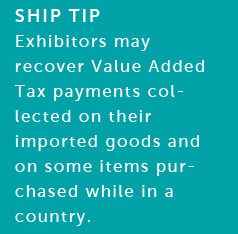
With TIBs, reimbursement after items leave the country can take from six to 36 months, while a return of the deposit from an ATA Carnet is generally much quicker so long as no claims have been filed. Depending on how many intermediaries are involved and what fees are assessed, the sum refunded from a TIB will likely be less than the original amount deposited. Value Added TaxWhen importing items that will not be returned, or when dealing with countries where ATA Carnets or TIBs are not an option, exhibitors might be able to pay VAT and duty fees up front, then seek reimbursement after returning home. Sometimes called duty Drawback or referred to as VAT reimbursement, the process for obtaining a refund of some or most of the fees paid upon entry to the country is a rather complex one. Each nation has a different formula for charging taxes and duties on items and materials brought into the country through customs, and August says they range from 0 to 80 percent of a shipment's value in duties, and can be up to 25 percent of the value in VAT. Countries vary widely not just on the amount charged, but on what is eligible for reimbursement, and exhibitors will need to seek country-specific guidelines to evaluate their chances for a refund. Paul Swift, principal at U.K.-based Worth Events Ltd., cautions that the rules for VAT change frequently, and what an exhibitor knew to be true last year or even last month may no longer be the case. For that reason, he says, exhibitors should look to the exhibitor services manual for guidance, as most organizers, at least in the United Kingdom and throughout the rest of the European Union, will publish helpful notes about VAT rules in the trade show's host country. The matter of getting VAT refunds can be so time consuming and complicated that many companies don't seek reimbursement. In fact, according to Boomerang Carnets, officials estimate billions of dollars in refunds are left behind. Les Baer, president of Meridian VAT Reclaim in North America, says leaving that money behind is an expensive mistake. "It is something that anyone who is considering going international should get a handle on, as there is an opportunity to recover significant costs incurred in the European Union where the average VAT rate is now over 21 percent," Baer says. "While it is important to understand these issues, it should not be a barrier for expanding globally." Meridian, which specializes in international tax matters such as obtaining VAT reimbursement for companies, provides booklets and other resources for businesses contemplating the VAT reimbursement question. Additionally, Ernst & Young Global Ltd. provides a comprehensive online database of countries and their corresponding VATs and regulations.
Simply put, a freight forwarder is an expert who can handle all the ins and outs of getting a shipment to an international venue. Dorn says when shipping internationally, he first seeks out a well-regarded freight forwarder in the destination country, then determines its U.S. affiliate. Using the show's official freight forwarder can simplify the shipping process too, Dorn says, as it has a particularly vested interest in getting your items to the show. When not using the show's official provider, there are as many freight forwarders to choose from as levels of service available from them, and it's up to you to decide just how much help you need and can afford.
Most international exhibitors enlist the help of freight forwarders for at least some of these services, finding their expertise with a particular country worth every penny of the cost. In fact, there are countries around the world, such as Argentina, where the customs process is so vexing that exhibitors are advised to never try to navigate it without an experienced freight forwarder. There are other countries, however, like Sweden, where the process is simple and straightforward enough that many experienced exhibitors find they can maneuver it without assistance. Whether exhibitors choose to use a freight forwarder or not, many find themselves in need of a customs broker, also called a customs-clearance agent skilled in moving a shipment through the entire customs process. Some governments require importers to use clearance agents; other governments have such a complicated process that it is just strongly advised.
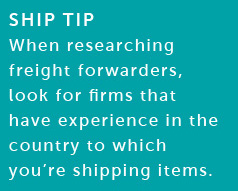
When selecting a freight forwarder, Lorenzini says it's critical to choose a company with an international shipping certification as well as expertise shipping to the specific country where you will be exhibiting. Verify references, she says, but make sure they are from clients who also shipped to your destination country. No doubt, there is a lot to take in to become a savvy international exhibitor, or at least one whose stuff shows up where it is supposed to and when — and for a price you can live with. The lingo alone can be confusing, much less the processes, paperwork, and people you will need along the way. But don't be daunted, because once you find the right information and the right partners, it will be smooth sailing when you pack up your exhibiting program and go searching for that global pot of gold.
|

 In terms of reliability, staying on schedule presents a greater challenge for ocean vessels than airplanes, and it is not uncommon for ships to arrive several days late. But timing the arrival of your shipment to an international destination is like threading a needle, as shipments sent too early can rack up exorbitant storage fees, and shipments sent too late will have no buffer for snags in the customs-clearance process. When it comes to evaluating actual costs for shipping, Jared Vineyard, a content writer for Universal Cargo Management Inc., says exhibitors need to consider more than just freight costs alone. "While the actual shipment cost of sea freight is usually cheaper than the shipment cost of airfreight," Vineyard says, "the warehousing fees at seaports are many times more expensive than those at airports."
 In addition, label each piece with the exhibitor's name, venue's name and address, exhibitor's booth number, and contact phone number. With pieces identified this way, shippers are responsible for each box of a shipment rather than a certain number of pallets, and wayward containers are more likely to find their way to your booth space and home again. Ron Burchett, president of Rogers Worldwide, cautions exhibitors to use the name of the venue and the show as it is published in that city rather than any slang name used within the industry, and to indicate which hall your booth will be located in if possible. Lorraine Lorenzini, director of international account management for Freeman, adds that if only shipping a few boxes, label them separately (rather than 1 of 4, 2 of 4, etc.). That way, any items held up in customs will not prevent other freight from reaching the show.

 The Harmonized Commodity Description and Coding System, also referred to as the Harmonized System (HS), is an internationally standardized set of codes for identifying products being imported, and each item in the shipment needs to be cataloged by one of the six-digit numbers created by the World Customs Organization. Customs agents in more than 200 countries around the world look to those codes for determining what duties and import regulations apply to components of a shipment.
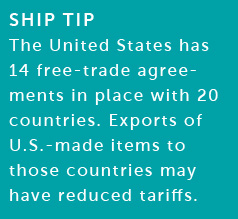 In addition, there are a host of other special certifications that may be required for shipping certain items depending on the destination country and the articles being shipped. This can include documents such as a certificate of analysis for dietary products, a certificate of dangerous goods for items such as chemicals or combustibles, or an insurance certificate that shows the shipment is insured against losses. Each country will have its own list of required documents and a list of what items are subject to them. Both United Parcel Service of America Inc. and FedEx Corp. provide free access to country descriptions and other helpful international shipping tools on their websites.
  To aid you in creating the shipping inventory, coding items, and determining what documentation is required, write a description for each article in a shipment. Include quantity, material, value, weight, origin, and intended use. That way, you'll be infinitely more prepared to navigate the paperwork process and avoid problems in customs.




Marketplace

- Audiovisual Equipment
- Convention Centers
- Event Design and Production
- Exhibit Fabrication
- Exhibit Producers
- Exhibit Rental
- Experiential Agency
- Flooring
- Graphics
- International Exhibit Producers
- Kiosks
- Lead Retrieval
- Modular Exhibit Systems
- Portable Display Systems
- Shipping and Transportation
- All Companies
3048R Sales and Marketing Alignment: How to Get ‑ and Stay ‑ on the Same Page
Feb. 10, 2026
3011R How to Grow Your Brand: Incorporating Brand Marketing into Your Exhibit Program
Feb. 19, 2026
4101R Boost Up: Promote Yourself from Service Provider to Strategic Business Partner
Mar. 3, 2026
6020R The @show Experience: Understand the Essentials of Exhibit Design
Mar. 10, 2026
7058R Authors Executive Series: Thrive Under Deadlines: Strategies for Success
All Sessions >>