exhibiting 101 |
|
 Natural Selection
Booth-space selection is not an exact science, but that doesn't mean you shouldn't conduct research to get the best spot. Here's what you need to know before it's time to select your space. By Candy Adams
 ou've probably heard this phrase before as the maxim of profitable real estate acquisition: "Location, location, location." And if you ask most exhibit managers, I think they'd agree that their booth's location – aka their marketing real estate – is an important part of their overall show strategy as well.
 While there is no perfect location on the show floor, some spots are better than others based on your own specific needs, such as required booth-space size and desired proximity to partners or competitors. You also need to take into consideration the traffic flow throughout an exhibit hall and how that might affect the area around your selected booth space. Exhibit managers often disagree on the psychology and bottom-line value of location-based booth-space selection. And studies conducted by Exhibit Surveys Inc. indicate that there isn't an appreciable difference in exhibitors' results based on location alone. "Research concludes that the location of an exhibit in a hall (front, rear, right, left, center, etc.) in and of itself is not a major factor in exhibit performance," says Skip Cox, CEO and president at Exhibit Surveys. "But exhibits in separate buildings and halls or on dead-end aisles, split-end aisles, or alcoves can experience pockets of low traffic." So is space selection an art based on guesswork, or is it an exact science based on extensive research? I think it's a combination of both. Imagine yourself in the show sales office to select your space for next year's event. The floor plan is spread out in front of you. To prepare for that pinnacle moment, and to help you make an informed decision, here is an overview of booth-selection preparation, strategies, and considerations. Define Requirements Before delving into space selection, determine how much real estate you need based on your current exhibiting budget, goals, and objectives. If you're using existing exhibit properties in a specific layout repeatedly, there may not be much opportunity for major change. But just because you've had a 20-by-20-foot island space at a particular show in past years doesn't mean you can't consider a 10-by-30-foot linear space or a 20-by-30-foot peninsula for the next iteration. Note that while attendees may not notice if you've changed the size of your booth space, your competitors likely will, particularly when space is reduced. So be ready for them to call out your diminished presence at the show and cite it as an indicator of your compromised financial state or lack of commitment to your industry. Study Floor Plans It's safe to say that nearly every show will have a different floor plan, so it's important to understand the lay of the land rather than throw a dart at the wall to pick your next booth space. Your selection decision should be guided by the sources of major traffic flow from shuttle buses, registration, and conference sessions; the number and location of entrances to the hall(s); attractions such as theaters on the show floor; and the contiguousness of the booth space. For example, available spaces could be in the same exhibit hall, spread out over multiple halls, or on different floors of the venue. If it is spread out, obtain floor plans for each area, along with the criteria for exhibiting in each area, as one section might be designated for a specific segment within your industry. As you peruse the floor plan, watch out for obstacles that can be barriers to your on-site success. The worst of these are huge weight-bearing support columns or fire apparatus (sometimes abbreviated on the plans as "FHC" for fire hose cabinets, "FA" for fire apparatus, and "FAS" for fire alarm strobes). These could throw a monkey wrench into your exhibit layout, depending on local regulations called setbacks, which specify an area that must remain clear of obstruction so people can access the safety equipment. Picking a booth space located immediately in front of a hall's freight doors (sometimes called "late setup areas") could mean a delayed start of your setup and costly overtime while freight is being loaded in. Also be prepared for immediate breakdown after the show to get your exhibit out of the way as empty crates are returned to exhibitors. Conversely, there are also show-floor attractions or elements that could draw extra foot traffic toward a specific section of the hall. These include entrances/exits, the registration area, show floor theaters and classrooms, exhibitor meeting rooms, food stations, and "people movers" such as elevators and escalators. Employ Booth Psychology There are many considerations when choosing your exhibit's future location on the show floor, and some exhibitors even segment the floor based (loosely) on psychology. In essence, they look at a floor plan and determine their ideal booth space by assuming attendees cover the show in certain patterns. I call these patterns The Triangle, The Rule of Right Turns, The Wide Aisles, The Bull's-Eye, and The Zoom Zone.  The Triangle: Looking at the map of the show floor, find the main entrance. Then draw a triangle from that door to the back corners of the show floor. The front corners of the hall, outside of the triangle, are sometimes known as "dead zones." That's because attendee traffic has a tendency to fan out from the main door toward the back of the hall, avoiding the front corners. Thus, exhibitors employing this rule would choose a space within the triangle. The Rule of Right Turns: For those highly organized, analytical attendees, the often-favored traffic route is to make a right turn as they come in the hall's entrance, proceed to the farthest aisle, then "drive" up one aisle and down the other, only making U-turns at the dead end of an aisle. In order to avoid crossing the path of attendees walking toward them, they visit only the exhibits that happen to be on the right side of their trail. So, looking at the floor plan, draw your way through the maze of exhibits to determine if you are on the right or left side of the analytical attendees' path.The Wide Aisles: The wider, main aisles of the show floor usually serve two purposes: 1) The fire marshal designates them for egress from the show floor in case of emergency, and 2) they are used during setup and dismantle as no-freight aisles so fork trucks have unobstructed access to the entire floor. Because these main aisles are wider, attendees have a tendency to spend more time walking them – or using them as traffic paths into and out of the hall – than the more narrow aisles, particularly during peak show hours. So exhibitors along these wider paths generally receive more exposure.The Bull's-Eye (aka Dead Center): My preference is to be in the "bull's-eye" – as close to dead center of the exhibit hall as possible, preferably on a wide cross-aisle where attendees will pass by more often. Being in the middle of the action at a trade show not only increases the odds that your booth will be seen, but also allows you to see more of the exhibit hall than if your booth space was in the back corner of the show floor.The Zoom Zone: This is the spot right in the front of the primary show floor entrance and is often occupied by the largest anchor exhibitors. Based on attendees zipping past in search of their must-see short-listed companies, exhibitors in this location need visual sizzle – something very colorful, moving, entertaining, or new – that will make attendees stop and venture in to learn more. The Triangle: Looking at the map of the show floor, find the main entrance. Then draw a triangle from that door to the back corners of the show floor. The front corners of the hall, outside of the triangle, are sometimes known as "dead zones." That's because attendee traffic has a tendency to fan out from the main door toward the back of the hall, avoiding the front corners. Thus, exhibitors employing this rule would choose a space within the triangle. The Rule of Right Turns: For those highly organized, analytical attendees, the often-favored traffic route is to make a right turn as they come in the hall's entrance, proceed to the farthest aisle, then "drive" up one aisle and down the other, only making U-turns at the dead end of an aisle. In order to avoid crossing the path of attendees walking toward them, they visit only the exhibits that happen to be on the right side of their trail. So, looking at the floor plan, draw your way through the maze of exhibits to determine if you are on the right or left side of the analytical attendees' path.The Wide Aisles: The wider, main aisles of the show floor usually serve two purposes: 1) The fire marshal designates them for egress from the show floor in case of emergency, and 2) they are used during setup and dismantle as no-freight aisles so fork trucks have unobstructed access to the entire floor. Because these main aisles are wider, attendees have a tendency to spend more time walking them – or using them as traffic paths into and out of the hall – than the more narrow aisles, particularly during peak show hours. So exhibitors along these wider paths generally receive more exposure.The Bull's-Eye (aka Dead Center): My preference is to be in the "bull's-eye" – as close to dead center of the exhibit hall as possible, preferably on a wide cross-aisle where attendees will pass by more often. Being in the middle of the action at a trade show not only increases the odds that your booth will be seen, but also allows you to see more of the exhibit hall than if your booth space was in the back corner of the show floor.The Zoom Zone: This is the spot right in the front of the primary show floor entrance and is often occupied by the largest anchor exhibitors. Based on attendees zipping past in search of their must-see short-listed companies, exhibitors in this location need visual sizzle – something very colorful, moving, entertaining, or new – that will make attendees stop and venture in to learn more. Sometimes I map out each of these scenarios on my show floor plan with a different color highlighter to see where they overlap; then, I select a space within the overlapping areas. 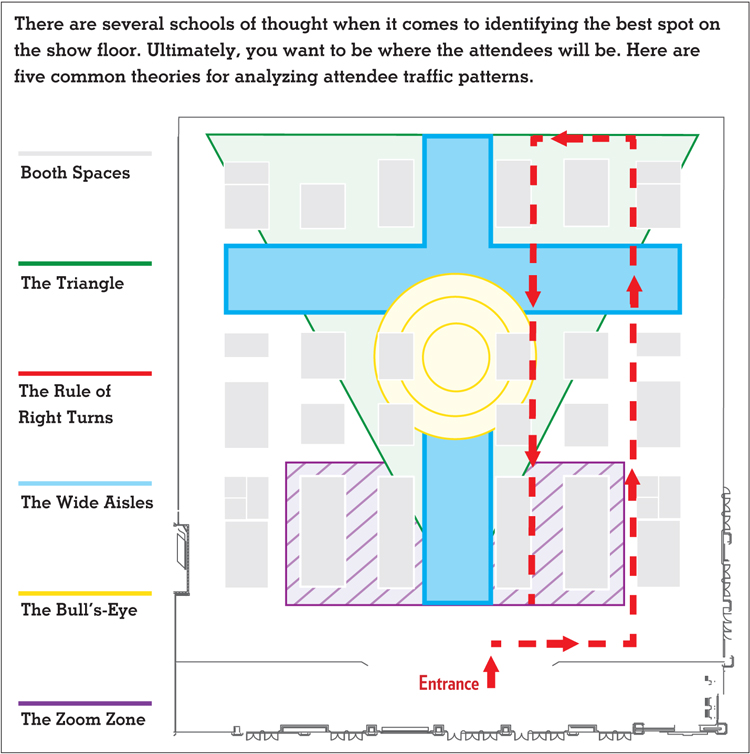 Get Creative Since exhibitors don't have a lot of control over when or how they pick booth space based on various show management methods that include points for longevity as exhibitors, cumulative square footage, sponsorship dollars spent, lottery systems, or first come/first served policies, booth-space selection can be a crapshoot despite your best efforts to get exactly what you need. But don't fret just yet. Just because you don't see the booth space of your dreams on the giant floor plan in the show management office doesn't mean the show manager can't get out a grease pencil and draw it in for next year. Some show managers allow a practice known as "cutting space," or combining smaller contiguous booth spaces into larger ones, as long as the newly combined booths don't block aisles to exits. Other shows have a formal do-over process to add exhibitors to a wait list for spaces that open up during the year. This can be due to companies dropping out because they didn't make their booth space payments on time, merging with another company or exhibitor, or going out of business before the show. With the average trade show doing about a dozen revisions of the floor plan throughout the year leading up to the show, your chances are very good that a more palatable space will become available. Also, don't be afraid to ask show management for a grace period if you need more time to consider your options. Use the time to let your legal or purchasing department review the contract before it becomes binding. And get any variances you need from show management in writing. Just as homebuyers must consider their wants and needs before a purchase, exhibitors have to determine their own criteria for selecting their booth space. Know what you want, consider your options, and if you still find yourself in a less-than-ideal spot, focus on traffic-building tactics in the booth to turn your low-traffic location into a high-traffic hub. According to Cox, "Factors under an exhibitor's control, such as exhibit size (specifically, the size of exhibit in proportion to size of potential audience), pre- and at-show promotion, and use of attention-getting techniques, are more important than location in attracting visitors." So maybe that old realtor's mantra should change to: Location, promotion, attention.
|




Marketplace

- Audiovisual Equipment
- Convention Centers
- Event Design and Production
- Exhibit Fabrication
- Exhibit Producers
- Exhibit Rental
- Experiential Agency
- Flooring
- Graphics
- International Exhibit Producers
- Kiosks
- Lead Retrieval
- Modular Exhibit Systems
- Portable Display Systems
- Shipping and Transportation
- All Companies
3048R Sales and Marketing Alignment: How to Get ‑ and Stay ‑ on the Same Page
Feb. 10, 2026
3011R How to Grow Your Brand: Incorporating Brand Marketing into Your Exhibit Program
Feb. 19, 2026
4101R Boost Up: Promote Yourself from Service Provider to Strategic Business Partner
Mar. 3, 2026
6020R The @show Experience: Understand the Essentials of Exhibit Design
Mar. 10, 2026
7058R Authors Executive Series: Thrive Under Deadlines: Strategies for Success
All Sessions >>